

TOP>Stock List>1955model Austin A30 Two-Door Saloon
1955model
Austin A30 Two-Door Saloon





↑↑↑Please watch the archived video above with audio if possible...
A 1955 Austin A30 cherished for many years by a film director who helped shape Japan’s classic-car culture... This adorable little car—one of the roots of modern motoring culture—still raises its semaphore indicators and darts lightly through today’s streets...!
Chapter One…
A tiny British car that captured the heart of a film director who helped create the images of Japanese car culture admired by an entire generation—all with a single word: “Cute…”
A 1955 Austin A30 that has remained in the family for many years…!
The 1970s… An era when the Showa period raced forward with vivid energy and freedom of expression…
As life gradually became more prosperous after Japan’s rapid economic growth, the automobile evolved from the once-dreamed-of ideal of “one family, one car” into something that reflected a person’s way of life, values, and even the spirit of the age itself…
As fascination with imported cars and sports cars grew, the automobile became a dream capable of carrying people into worlds they had never yet seen…
Those dreams and desires were vividly portrayed in films and television dramas, then the overwhelming center of popular media. At times their surreal worlds were so bold they would be impossible to depict today, and even more than half a century later those experiences remain alive in memory. For veteran enthusiasts reading this, they may well stand as the very origin of your love for cars…
The Daitokai series broadcast from the late 1970s into the early 1980s, The Resurrection of the Golden Wolf starring the late Yusaku Matsuda, Detective Story, the Seibu Keisatsu series, and more…
They captured the free, vibrant energy of the Showa era with astonishing sharpness and unforgettable visual force. Surely I was not the only one transfixed by Yusaku Matsuda’s near-manic performance as he blasted a bright-red Lamborghini Countach LP500S through the heart of the metropolis…
With the greatest respect, this 1955 Austin A30 was once owned by a man who brilliantly grasped the mood of his age, expressed it on the silver screen alongside great actors with remarkable sensibility, and gave our generation—those of us who simply cannot stop loving cars—memories that became the very starting point of our lifelong aspirations. He was, quite literally, one of the people who shaped an era…
As a director, he even made a cameo appearance in The Resurrection of the Golden Wolf as an imported-car salesman, recommending to Tetsuya Asakura, played by Yusaku Matsuda, that famous bright-red Lamborghini Countach LP500S known as the “Wolf Countach”…
Today, this 1955 Austin A30 two-door saloon has been inherited by the owner’s family…
It was loved and cared for by its former owner for so many years that even the family can no longer remember exactly when it first became part of his life…
The exterior, repainted many years ago, has now acquired just the right amount of age. The surviving original interior and the A-Series engine—the very origin of the breed—remain together with period ancillaries in astonishing condition. As a car with a genuine owner history, it stands before me with an irresistibly understated aura…
Its first registration in Japan was December 1956…
It is believed to have been brought to Japan as a parallel import the year after it was released as a new car, and its chassis still clearly carries the old Japanese authority-stamped number “神[42]72342神”…
Meanwhile, the original British serial number shown on the registration document is “A2S4 158148.” Cross-referencing this number with the annual chassis-number data in Barney Sharratt’s well-known A30 reference, Post-War Baby Austins A30-A35-A40, reveals a fascinating fact…
Serial No. “A2S4 158148.”
A2S4 is the model code for an Austin A30 two-door saloon. British annual chassis-number records show 1955 production beginning in the 96,510 range, while 1956 begins in the 181,318 range…
In other words, this car’s number, 158148, clearly falls between those figures and therefore within the 1955 production range…
And here is another wonderfully original detail that can be confirmed on the actual car…!
During A30 production, the carburettor was changed from the Zenith 26JS to the 26VME, with that change taking place in September 1955…
The production period indicated by the serial number aligns beautifully with the period of the 26VME carburettor actually fitted to this car. Mechanically, this strongly supports the build date suggested by the serial-number evidence…
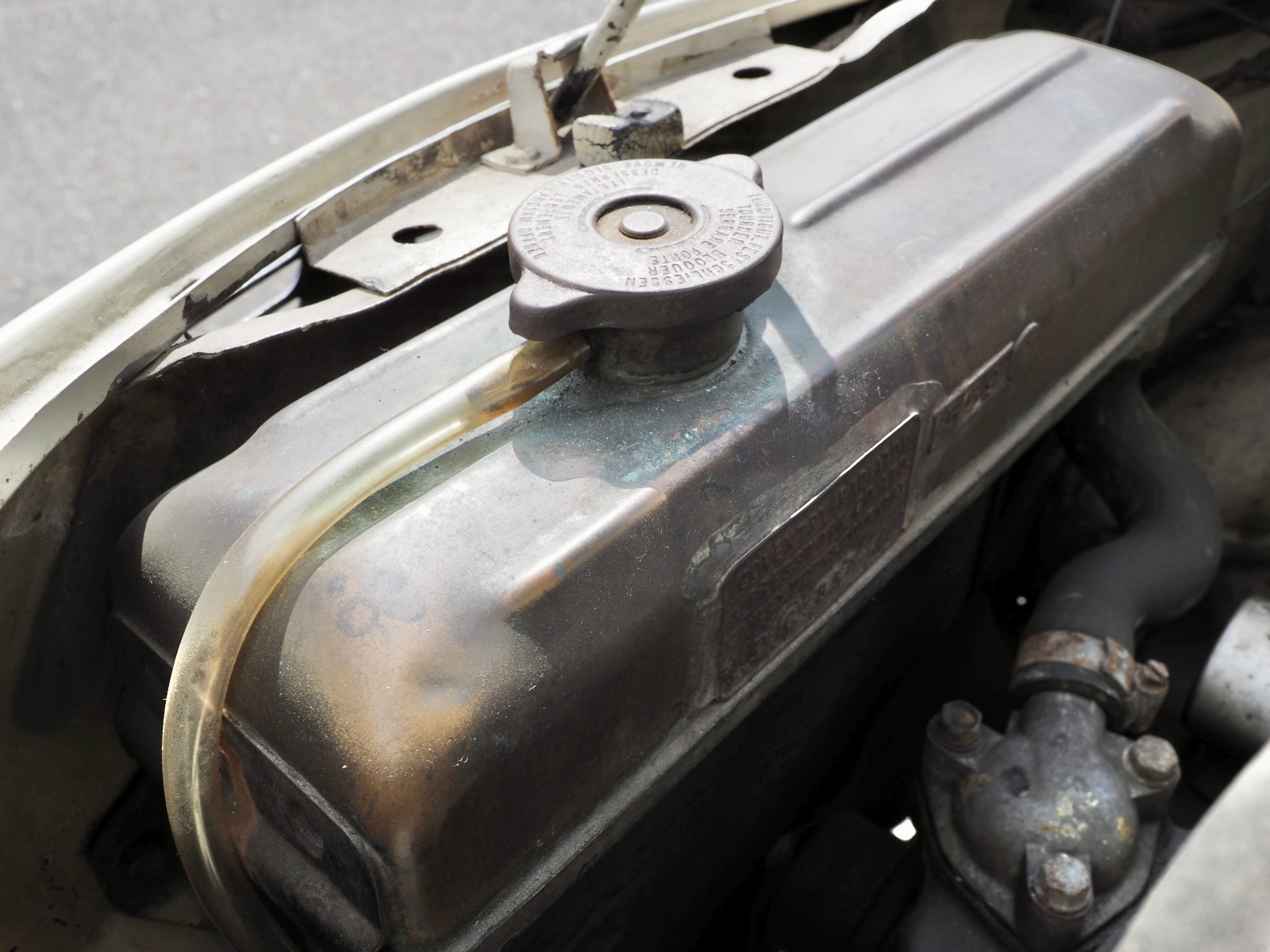
Its first Japanese registration was in December 1956. If it was built in Britain in the latter half of 1955 and subsequently imported privately to Japan, the timeline fits very naturally. The original A.C. air cleaner still fitted to the carburettor, the old-style dynamo—which is so often replaced by an alternator after electrical trouble—and the lively 803cc A-Series OHV inline-four all remain in place, preserving the atmosphere of the period and making this car utterly irresistible…
Lift the charming “Flying A” mascot on the bonnet and an extraordinarily evocative, period-correct scene appears beneath it—absolutely wonderful…!
The engine and sump, painted green from the period, retain peeling paint and the patina created by decades of use, telling their own story of age. Even the slight oil seepage that is naturally present feels endearing. British enthusiasts who keep genuinely old classics often laugh it off with the familiar line, “That just proves there’s oil in it…”
It is precisely a car of this age that gives those words their true meaning…
Pull the starter and this little A-Series engine wakes with remarkable ease…
It is simply lovable…
The A-Series engine later went on to power the Mini and countless other British cars, and the A30 was the first model to use the 803cc unit at the very beginning of that story…
That small-displacement 803cc OHV engine delivers the gentle, familiar A-Series note associated with cars of this era…
It settles into a clean idle with light mechanical chatter, while the wonderfully old-fashioned and mechanically distinctive Zenith 26VME single carburettor draws air through an A.C. air cleaner whose survival itself feels almost miraculous. Together they make you feel that a machine from the 1950s is still very much alive today…
Simply enjoying this idle becomes an extraordinarily rich and rewarding moment…
This is what it means to experience a classic car in everyday life…
It gives its owner a kind of pleasure that modern cars, increasingly reduced to mere transportation, can never provide…
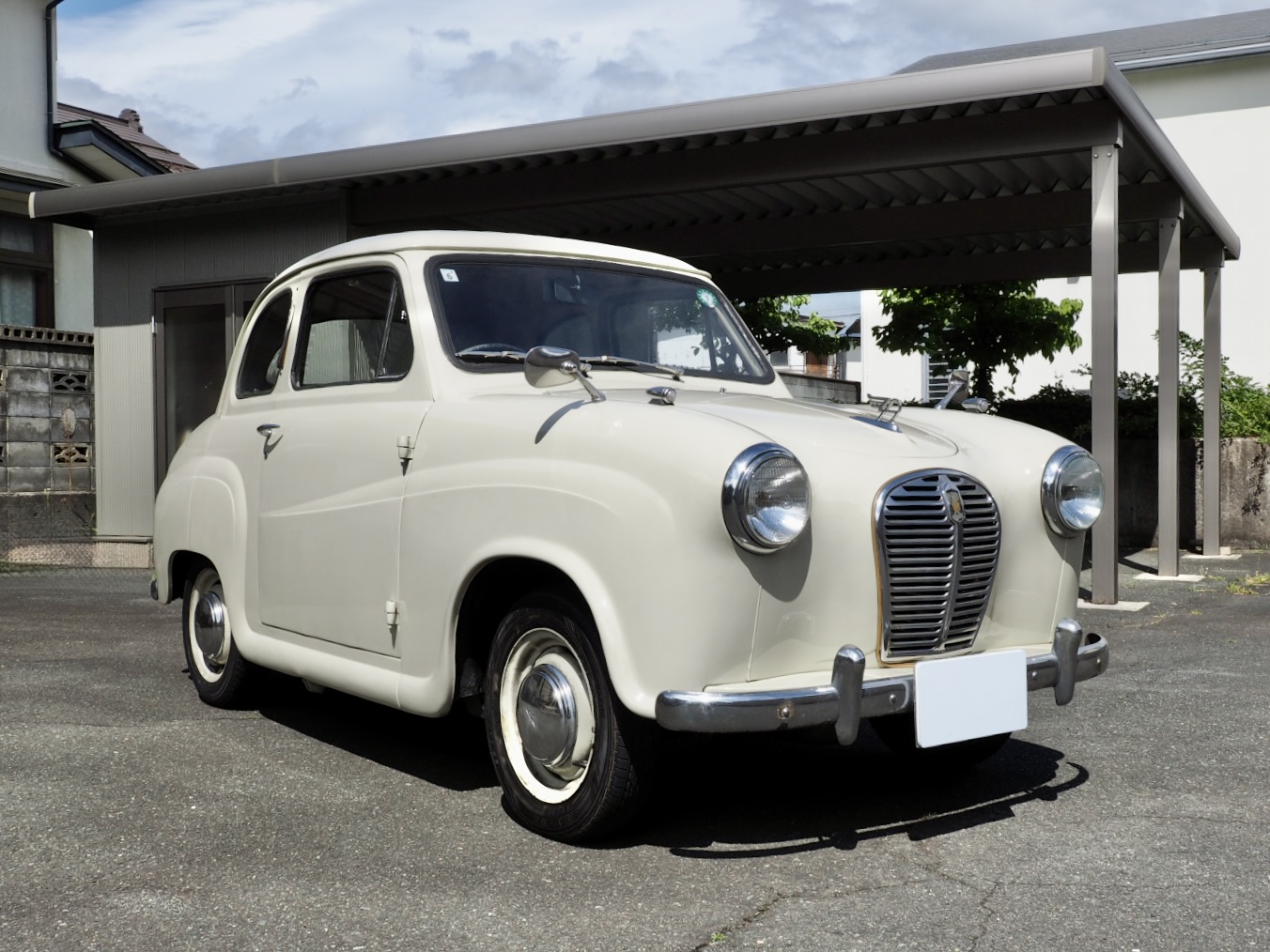
And what an adorable exterior it has…
The body appears to have received a full repaint many years ago…
The ivory-toned body now carries a beautiful period character, having aged further since that repaint. The chrome bumpers, grille, Austin crest badge, hubcaps, and other details all possess a wonderfully mellow shine appropriate to their age…
Only one small area of paint bubbling was found, at the lower section of the right rear fender…
The graceful signs of seventy years found throughout the details add enormously to the car’s charm. Rather than being polished into flawless concours condition, it retains the natural patina of a British classic that has actually been used for decades. Combined with its remarkable history, that patina gives this particular car an exceptional aura…
At just 3,490 mm long, 1,400 mm wide, 1,480 mm high, and weighing only 680 kg, its body is astonishingly small by modern standards—and wherever it goes, it is sure to be greeted with warm smiles…
Round Lucas headlamps… a tall, classically styled chrome grille at the center… Austin’s traditional “Flying A” mascot standing proudly yet charmingly at the tip of the bonnet… softly swollen front and rear fenders… and a tiny cabin with rounded windows…
Yet what is especially moving is the body-side design: despite its small size, it carries a flowing swage line characteristic of the 1950s and reminiscent of the open-wheel era that came before…!
The A30’s body design was the work of T.K. Garrett, who had experience in aircraft structural engineering…
To create Austin’s first fully developed monocoque body without relying on a separate conventional frame, the thin steel panels themselves had to provide structural strength. The narrow swage line flowing from the front fender through the doors to the rear quarter was therefore designed not only to give the body visual character, but also to increase panel rigidity…
The A30… What an adorable design, and how thoroughly it must have captured the hearts of ordinary motorists in Britain and beyond. There is not a single intimidating line anywhere on the car…
Its design is superb, with a uniquely friendly character that seems to change expression depending on the viewing angle…
The family told us a wonderful story about the film director who loved this car for many years: while traveling through Tokyo, he happened to see it being carried on a transporter and immediately asked if he could buy it on the spot…
With just one word—“Cute…” —he fell for it instantly. You can almost picture the exact moment…
One of the A30’s defining features is surely the semaphore Trafficator housed inside the B-pillar…
This semaphore still works properly in conjunction with its period Lucas ebonite switch…! That alone is a wonderfully satisfying feature…
The lighting equipment also retains an array of vintage Lucas components: round headlamps, compact rear lamps, fender-mounted sidelamps, chrome mirrors, and more. The materials and forms of a 1950s British car remain richly present in every detail…
Apart from tyres being replaced as necessary over the decades, the simple steel wheels and beautiful chrome hubcaps bearing Austin’s Flying A have remained unchanged, supporting successive drivers through the years…
Naturally, the rims and caps show appropriate age, but that patina suits the small ivory body perfectly and creates an atmosphere unique to this car—one whose untouched period character is enormously appealing…
Still talking about the exterior… (laughs)
Step inside, and the charm of this car deepens even further…!
The ivory dashboard and red leather interior, all appearing to be original, embody the atmosphere of an ordinary British car from the 1950s…
A slender, large-diameter original ebonite steering wheel retains the Austin crest at its center, while a Smiths 70 mph speedometer with wonderfully period typography sits simply in the middle of the dashboard and tells you everything you need to know…
Another characteristic A30 feature is the long handbrake lever positioned to the right of the driver. Vintage Lucas switches line the dashboard area, joined by an original period heater-control unit that is a delight to look at…
And most wonderful of all are the red leather seats, which appear to be original to the period…
From front to rear, they retain excellent texture despite the natural sheen and creasing created by decades of use. The vertical stitching, piping, and overall appearance strongly preserve their period-original character…
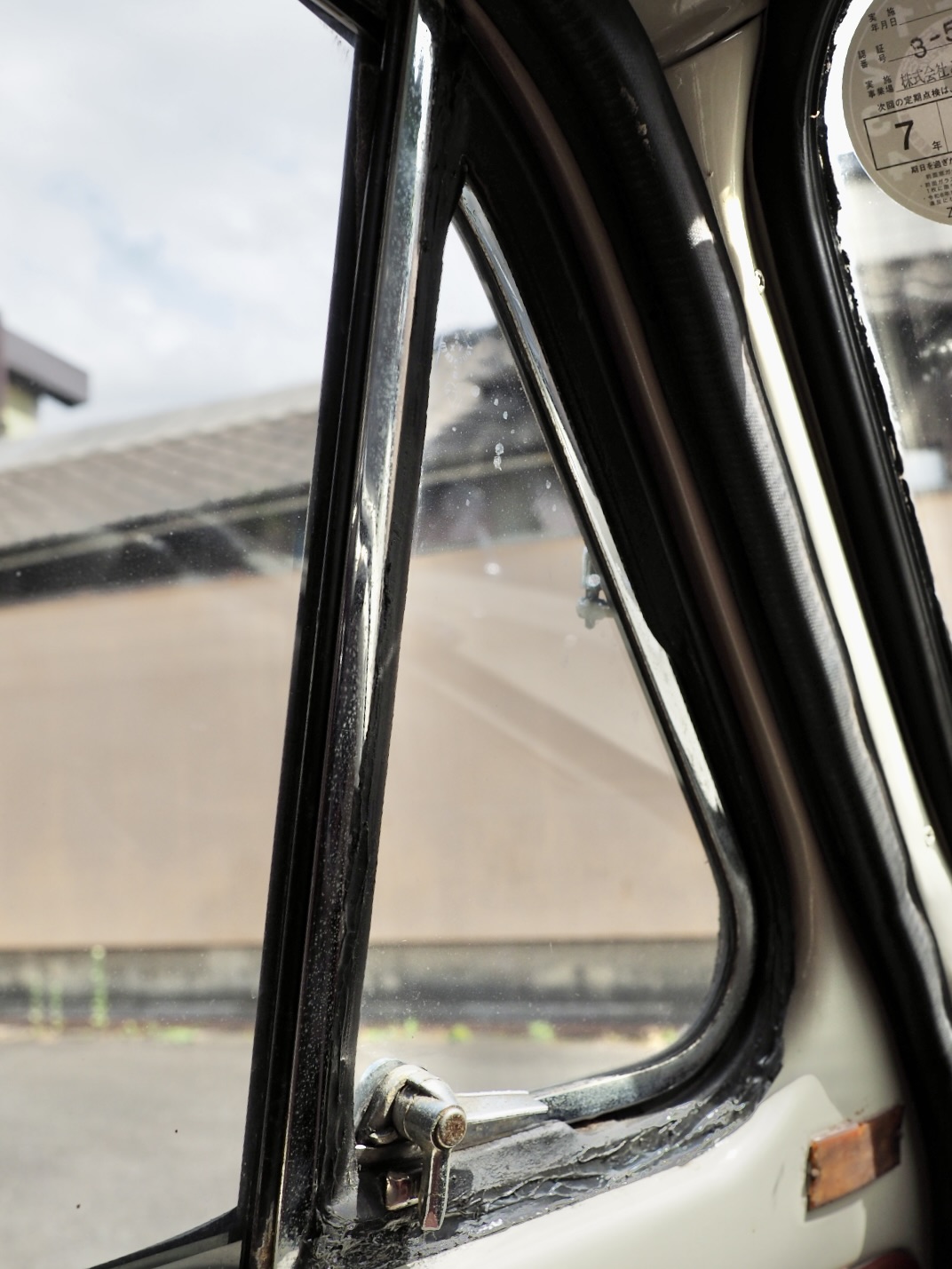
As for the quarter windows…
Unfortunately, they cannot currently be opened. The reason is that the former owner disliked rainwater entering through them and personally sealed the area with caulking as a countermeasure…
Ideally, the old sealant should be carefully removed, replacement quarter-window seals sourced from the UK, and the area refinished properly…
As you have probably already realized, a classic car carrying genuine history possesses an entirely different kind of value…
For more than seventy years it has passed from person to person as a storyteller, receiving the care it needed while surviving to the present without losing the essential appearance of its era…
Standing in front of this Austin A30 makes the meaning of
that history remarkably easy to understand…

Chapter Two…
One of the origins of modern motoring culture… The “little people’s car” that postwar Britain dreamed of… Reading the history of the 1955 Austin A30 reveals the enormous charm contained within this tiny automobile…!
In the early 1950s, as Britain tried to return to everyday life after the Second World War…
What people wanted from a car was a dream itself: the simple ability to put a family inside and travel freely represented prosperity and a brighter future for those living through the postwar years…
It was into this era that Austin launched the small family car known as the A30.
Introduced at the 1951 Earls Court Motor Show as the “New Austin Seven,” the A30 revived the name of the prewar Austin Seven so familiar to British motorists, yet beneath the name it was a completely new generation of automobile…
It was Austin’s first model with a monocoque body and the first to use the BMC A-Series OHV engine that would later become famous in the Mini…
This tiny car marked a major turning point for Austin in the postwar era.
The British small-car market already had a formidable rival in the Morris Minor, introduced in 1948…
The A30 was developed as Austin’s answer to the Morris Minor, yet in 1952 the corporate groups centered around Austin and Morris merged on a grand scale, creating BMC…
And here comes a wonderfully interesting twist…!
The newly developed 803cc OHV engine created for the A30 as a rival to the Morris was, after the BMC merger, adopted by the Morris Minor as well…!
Two cars that had been competitors only the day before suddenly shared the same engine through corporate consolidation…
And this very 803cc unit became the starting point of the A-Series engine family that would support British motoring for decades to come…
This small A-Series engine later grew to 948cc and 1098cc and, as everyone knows, went on to power the Mini, continuing in various forms right up to the millennium. The long story of the engine that became the heart of the Mini began beneath the tiny bonnet of this A30…
The engine was not the only revolutionary aspect of the A30…
Austin moved decisively away from the separate-frame construction it had previously used and adopted, for the first time, a monocoque structure in which the body itself carried structural strength…
Today monocoque construction is taken for granted, but for Austin at the time it represented a clear technological shift—an important step toward combining low weight and strength while extracting as much interior space as possible from a small body…
At the same time, the A30 uniquely retained mechanisms that still reflected an earlier chapter of automotive history…
This is what makes it so fascinating to drive today: while the front used then-modern independent suspension with coil springs, the rear retained a leaf-sprung live axle. Even the brakes combined new and old technologies, with hydraulic drums at the front and mechanically rod-operated drums at the rear…
And for direction indication, the A30 used semaphore Trafficators—the very devices that survive so beautifully on this car today…
When the driver operates the switch, a small illuminated arm rises from the B-pillar to indicate the direction of turn. For generations raised only on flashing indicators, the mechanism is irresistibly charming—and for enthusiasts, utterly delightful…
A new monocoque body and newly developed OHV engine, yet with semaphores and mechanical rear brakes still retained…
Within the A30, technologies from the boundary between prewar and postwar motoring coexist, capturing the transition from the classical automobile as a machine to the modern mass-market family car…
The A30 first appeared only as a four-door saloon, but a two-door saloon was added in late 1953…
The A2S4 model code assigned to this car identifies precisely that two-door saloon body style…
Built in 1955, this example dates from the period when the A30 had moved beyond its earliest trial-and-error phase and was maturing as a model…
Then, in 1956, the A30 evolved into the A35 with an enlarged 948cc engine…
Although the A30 and A35 look very similar, the A30’s combination of the small early 803cc A-Series engine, now wonderfully distinctive semaphore Trafficators, and Austin’s first full monocoque construction gives it a historical significance rather different from that of its A35 successor…
The greatest charm of this car may be that it lets you directly experience the dream of motoring that symbolized postwar Britain…
In a Britain emerging from war, an ordinary family could own its own car, go to work, go shopping, and on weekends load everyone in and travel a little farther afield…
It was a beloved “little people’s car” created for exactly that life…
And within its tiny body were technologies pointing to the future: the A-Series engine that would lead to the Mini, and the monocoque construction that is now standard in modern passenger cars…
The 1955 A30 before us therefore cannot be measured simply as a cute British car built some seventy years ago. Once its historical context is understood, there is unquestionably far more to it than that…
And that is exactly why, at least to my eyes, it absolutely does not need to be restored into a gleaming, freshly finished show car…
I cannot help but feel that way…

Chapter Three…
A British car more than seventy years old raises its semaphore and slips delightfully through a modern city…!
We drove it! Author’s afterword on the 1955 Austin A30…!
This 1955 Austin A30 remains carefully preserved today under the ownership of the family…
On the day of our interview, the family owner drove it energetically through the city for us…
Please be sure to watch the video footage as well…
Pull the period pull-type starter and the A-Series engine wakes immediately without fuss. It settles into an astonishingly steady rhythm for an engine that still carries the clearly visible authority stamping applied more than seventy years ago, producing that familiar OHV sound while the slender steel exhaust delivers a warm, mellow note unique to metal pipework…
To eyes accustomed to modern dashboards built from moulded plastics and integrated functional modules, this is extraordinarily fresh…!
A dashboard formed as part of the body itself and painted in the same color—so unmistakably 1950s, wonderfully pop, and simply delightful…!
At its center is essentially a single beautifully styled vintage Smiths instrument with elegant period typography. It does more than convey driving information; it makes the cockpit visually joyful and turns every classic drive into something bright and charming…
We bring the dependable OHV engine up to speed, engage a gear, and set off…
Only first gear lacks synchromesh; second through fourth are equipped with synchromesh…
Driving an old British gearbox of this type follows exactly the same basic technique as later MGs and similar cars…
When stopped, use the second-gear synchro first: select second briefly, then move into first, and the gear engages normally without protesting…!
For enthusiasts, there is something wonderfully relaxing about listening to the familiar A-Series sound known from the Mini while enjoying an unhurried classic-car ride with no need to tense up and nothing dramatic happening. Before you realize it, you find yourself grinning from the inside…
Exactly…! It simply makes you smile from the heart…
A deeply satisfying driving experience filled with a mysterious kind of “vitamin for the soul”…
Nothing extraordinary happens—and yet the more you drive it, the more enjoyable it becomes…
After driving it, I was reminded once again that this is exactly what an Austin A30 is…
For clarity, one point should be mentioned: the semaphore Trafficators themselves operate beautifully, but they currently do not illuminate…
According to the family, the car nevertheless passed its periodic inspections for many years at the local workshop they had always used…
There are now numerous kits available overseas to modify original Trafficators so that they illuminate, but depending on where the car is registered, such a modification may be required. Please keep this possibility in mind…
The former owner introduced at the beginning—the man who helped create Japanese automobile culture through the visual medium of film…
He was unquestionably a true car enthusiast, and in addition to this Austin A30 he reportedly enjoyed such notable cars as an early Nissan Silvia and a Mercedes-Benz 190SL throughout his life…
The family also told us that in the days when he stood at the front of film sets with a megaphone in hand, he enjoyed spirited drives together with the late Yujiro Ishihara and Ishihara’s Mercedes-Benz 300SL Gullwing…
One day, while the afterglow of the interview was still vivid, there was no way I could resist watching the 1979 film The Resurrection of the Golden Wolf starring the late Yusaku Matsuda…
My own beloved Mercedes-Benz W111 Fintail appears as a movie car—and is spectacularly destroyed after a car chase… (laughs)
I was once again captivated by the film’s impossibly hard-boiled, surreal world, the kind of thing that could scarcely be recreated today. And naturally, the appearance of the Lamborghini Countach LP500S brought back the excitement I felt the first time I saw it. I could not help but respect the sharp sensibility that created such a remarkable world…
And this was the little car that owner, with that very same sensibility, spotted and simply called “Cute…”
Which is why I chose the title…
A 1955 Austin A30 cherished for many years by a film director who helped shape Japan’s classic-car culture... This adorable little car—one of the roots of modern motoring culture—still raises its semaphore indicators and darts lightly through today’s streets...!

That is how the title came to be…
If you would like to see this 1955 Austin A30 in person, touch its deeply moving history, and experience both its important place in automotive history and the feelings of its owner, please come to Yamagata Prefecture, Japan…
As this is a private-party sale, no consumption tax or dealer-related fees apply.
In connection with the purchase, the buyer will be responsible for the prorated automobile tax (annual amount: ¥33,900) and settlement of the recycling deposit (¥10,030).
Transportation should likewise be arranged by the buyer; however, our company owns an all-weather, fully enclosed flat-loader transporter and can also accommodate delivery requests.
Please feel free to contact us if you would like assistance…
【Regarding Inquiries…】
The vehicle on this page is listed on Estate Sale Supremacy®, a cross-border e-commerce platform for classic and collectible automobiles.
What is a supreme—“Supremacy”—estate sale…?
Estate Sale Supremacy® is a Japanese interpretation of the North American estate-sale culture, introducing cherished vehicles through owner interviews, written stories, and video.
We present the current owner’s feelings as faithfully as possible, preserving memories in the heart while helping ensure that the vehicle is passed securely to the next generation, from introduction through sales brokerage.
We conduct detailed interviews with the current owner, including past maintenance records, repair history, and accident history. If a vehicle has a major accident history, or if the current owner’s period of ownership is extremely short and details cannot be confirmed, we may decline the feature. We make every effort to provide prospective buyers with as much reassurance as possible.
This article was written based on an approximately three-hour interview with the owner beginning at 1:00 p.m. under clear skies on June 9, 2026. Because the vehicle could only be checked within a limited period, the description may not represent its condition with 100% accuracy. Not every statement in the article has been independently verified, and comments regarding condition reflect the weather at the time of the interview and the author’s subjective impressions. Please understand this in advance.
For questions regarding the listed vehicle or to request an in-person inspection, please contact us using the form at the bottom of this page. As this is a private-party transaction, and to discourage casual viewing, inspections are limited to customers genuinely considering purchase.
Thank you very much for your consideration.






The detailed condition of the vehicle is described in each photo.
On the top slide you will find 50 attractive photos of the vehicle! Please click on a photo to view it with its description. Click outside the picture to return to the page.
SPEC
Length
3,490 mm
Width
1,400 mm
Height
1,480 mm
Weight
680 kg
Engine Displacement
803 cc
FOB Tokyo price is